What is a VLAN
A VLAN is a Virtual LAN. Which brings forward the question what is a LAN? A LAN, is a Local Area Network. In this specific use case we are referring to a network that belongs to the same broadcast domain.
A broadcast domain refers to a single area or segment where a broadcast sent by a node or device will be received by all other nodes in the area, without leaking into any other areas. You can think of think as fences in a neighborhood. Where the neighborhood is a complete entity, encompassing all of the fences. While the fence indicates points of demarcation or separation.
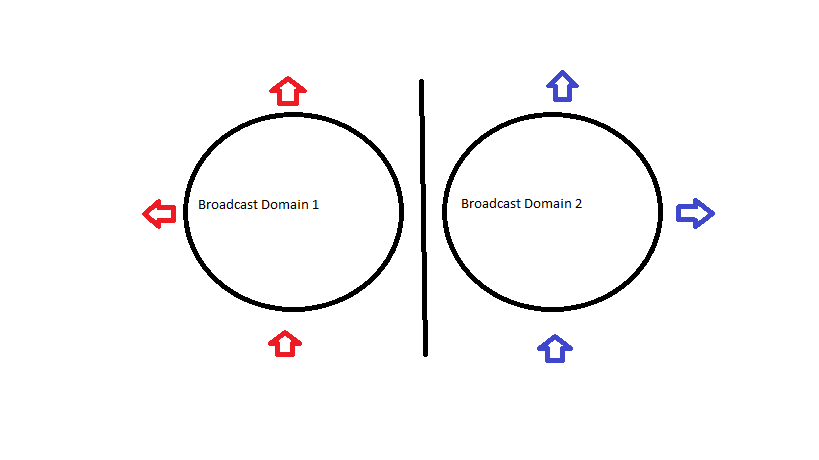
Here’s a visual example without bringing networking devices into play.
In the picture below where the arrows represent broadcast messages/packets. You see that even though they are forwarded in all directions in their respective broadcast domains. The broadcast messages do not pass between broadcast domains.
Relating all of this back to networking. VLAN’s act as a way to virtually segment these LANs or Broadcast domains. So again we can take the fence example above. This time with the switch representing the neighborhood and the fence representing the separate VLAN’s on the switch. I do want to state that LAN does not always mean Broadcast Domain as sometimes LAN can refer to all on-premises devices as well as many other things.
So for example in the screenshot below broadcast for VLAN 3 would go out of Gi1/0/4 & Gi1/0/7 (excluding of course the interface it entered on). Whereas Broadcast that entered on a port in VLAN 1 will have the option to go out of many more interfaces as VLAN 1 is the VLAN is that interfaces on this switch default to. You can also see that the delimiting or unique tribute of VLAN is the VLAN ID EX VLAN (1), VLAN (2) VLAN (3) etc…. In the Cisco world, these are saved in the vlan.dat file. You also can devote specific names to the VLANs, in the field you will normally see the name based on or the department or the specific zone that the end host are plugged into. In my example, you see there are VLANs for Wired(default), Wireless and IOT (Internet of Things).

So in review, a VLAN is a logical separation of switch or broadcast domain. This is helpful as it can allow you to segment traffic as well as improve bandwidth (in some cases) by preventing unnecessary broadcast between end hosts.
In the next post, I’ll present a lab where we can test this out as well as walk you through it.
 CCIE or Bust